Self Care Sobriety
SelfCare Sobriety: The 12 Dimensions of Living With Intention
There’s a reason so many of us feel exhausted, burned out, or disconnected—even when we’re “doing all the right things.” Most wellness advice focuses on fixing one part of life at a time. But humans don’t live in compartments. We live in systems.
SelfCare Sobriety is not sobriety in the traditional sense. It’s an intentional shift toward awareness, balance, and compassion in how we care for ourselves and how we live. It’s about noticing what we consume, how we cope, how we rest, how we relate, and how we show up—across all areas of life.
Instead of chasing perfection, SelfCare Sobriety invites us to practice honest reflection, gentle boundaries, and sustainable change.
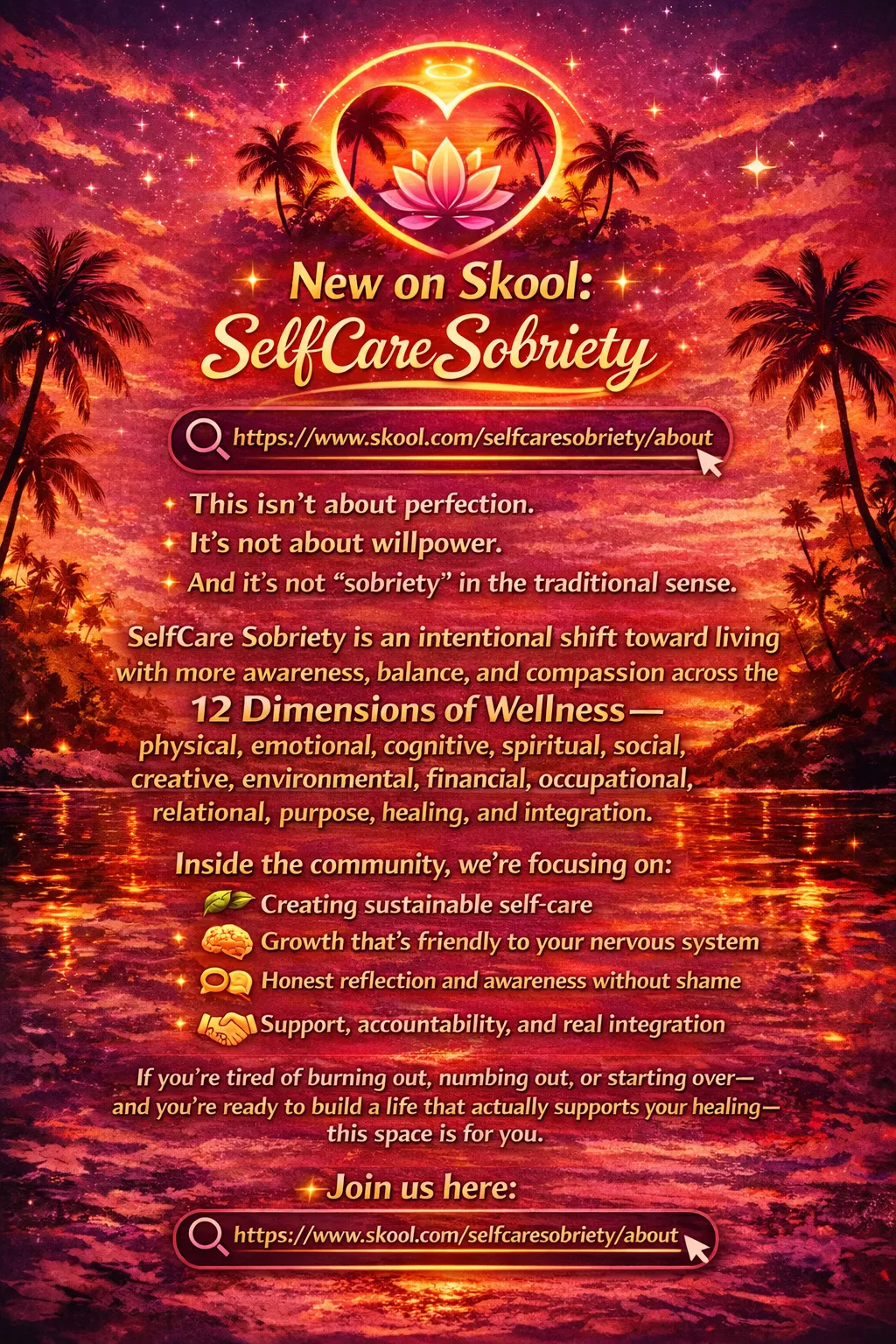
In the Afterglow community, we explore SelfCare Sobriety through 12 interconnected dimensions. Think of these not as boxes to check, but as lenses to help you notice where you’re nourished—and where you might be running on empty.
1. Physical
This is the most familiar dimension: sleep, movement, nutrition, rest, medical care, and how you treat your body day-to-day. SelfCare Sobriety here isn’t about punishment or rigid rules—it’s about listening. What does your body need today? More rest? More water? Gentler movement? Fewer stimulants? More nourishment?
Sobriety in this dimension means moving away from neglect, overdrive, or self-attack—and toward care, pacing, and respect for your nervous system.
2. Emotional
Emotional self-care is about allowing yourself to feel without numbing, suppressing, or judging those feelings. It includes emotional literacy, boundaries, self-compassion, and healthy expression.
SelfCare Sobriety here means noticing when you’re using distraction, busyness, or substances (including emotional ones like people-pleasing or avoidance) to escape feelings—and choosing presence instead.
3. Cognitive
This dimension focuses on your thoughts, beliefs, inner narratives, and mental habits. How do you talk to yourself? What stories are you reinforcing? What information are you consuming?
Cognitive SelfCare Sobriety is about stepping out of automatic, harsh, or catastrophic thinking and practicing more intentional, reality-based, compassionate perspectives.
4. Spiritual
Spiritual doesn’t have to mean religious. It’s about meaning, connection, values, and your sense of something larger than yourself—whether that’s nature, humanity, purpose, or inner wisdom.
SelfCare Sobriety here means making space for reflection, awe, values, and alignment instead of living purely in survival mode or productivity pressure.
5. Social
This dimension looks at community, belonging, support, and how you engage with others. Are your relationships nourishing or depleting? Do you have spaces where you can be real?
Social SelfCare Sobriety is about choosing connection over isolation, and honesty over performance—while also honoring your limits and energy.
6. Creative
Creativity isn’t just art—it’s expression, play, curiosity, and imagination. This is the part of you that wants to explore, experiment, and create without needing it to be productive or perfect.
Sobriety here means loosening the grip of pressure and allowing creativity to be a source of regulation, joy, and self-connection rather than another standard to meet.
7. Environmental
Your environment shapes your nervous system more than you might realize. This includes your home, workspace, digital environment, and the sensory inputs around you.
Environmental SelfCare Sobriety is about reducing chaos where possible and increasing cues of safety, calm, and support—even in small, imperfect ways.
8. Financial
Money carries stress, shame, fear, and survival for many people. This dimension isn’t about being perfect with finances—it’s about awareness, honesty, and gentler relationship with money.
SelfCare Sobriety here means moving away from avoidance, panic, or self-blame and toward clarity, support, and realistic, compassionate planning.
9. Occupational
This includes your work, roles, responsibilities, and how you spend your energy in service or labor—paid or unpaid. Does your work align with your values? Does it drain you past capacity?
Occupational SelfCare Sobriety is about recognizing limits, addressing burnout, and seeking more sustainable ways to engage with responsibility and purpose.
10. Relational
While social looks at community broadly, relational focuses on the quality of your close relationships—including the one you have with yourself.
Relational SelfCare Sobriety means practicing boundaries, repair, honesty, and self-respect instead of staying stuck in patterns of over-giving, conflict avoidance, or self-abandonment.
11. Purpose
Purpose is about direction, meaning, and what gives your life a sense of “why.” This doesn’t have to be a grand mission—it can be as simple as living in alignment with what matters to you.
SelfCare Sobriety in this dimension means checking in with whether your life is being driven by fear and survival—or by values and intention.
12. Healing & Integration
Healing isn’t about becoming a different person—it’s about becoming more fully yourself. Integration is where insights, growth, and self-awareness turn into real-life changes.
This dimension of SelfCare Sobriety is about patience, consistency, nervous-system safety, and letting change happen in ways that are sustainable, not forced.
Bringing It All Together
SelfCare Sobriety isn’t a checklist. It’s a practice of noticing.
Noticing where you’re overextended. Noticing where you’re disconnected. Noticing where you’re actually doing okay. And gently, compassionately, choosing to care for yourself more honestly.
You don’t have to work on all 12 dimensions at once.
You don’t have to do this perfectly.
You just have to start paying attention—and choosing yourself a little more often.
That’s the heart of SelfCare Sobriety.
And if you’re walking this path with us at Afterglow, you don’t have to do it alone.
Ready to Go Deeper? Join Us
If this way of thinking about self-care resonates, there are two ways to keep walking this path with support, structure, and community:
✨ Join the SelfCare Sobriety community on Skool
Inside Skool, we explore these 12 dimensions together with reflections, prompts, gentle accountability, and real-life integration. This is a space for nervous-system-friendly growth, honest conversations, and sustainable self-care—without shame or perfectionism.
Find us here: https://www.skool.com/selfcaresobriety/about
💛 Work with Afterglow Coaching & Consulting
If you want more personalized, trauma-informed support, Afterglow offers coaching and holistic services designed to help you integrate these dimensions into your actual life—not just your ideas about change. Whether you’re navigating burnout, recovery, life transitions, or healing, you don’t have to do it alone.
Start where you are. Bring what you have. And let’s build a life that actually supports your healing—together.