When Your Nervous System Is Running the Relationship
When Your Nervous System Is Running the Relationship
Most people don’t stay stuck in painful relationship patterns because they’re broken, weak, or “bad at relationships.”
They stay stuck because their nervous system is caught in a loop.
It often looks something like this:
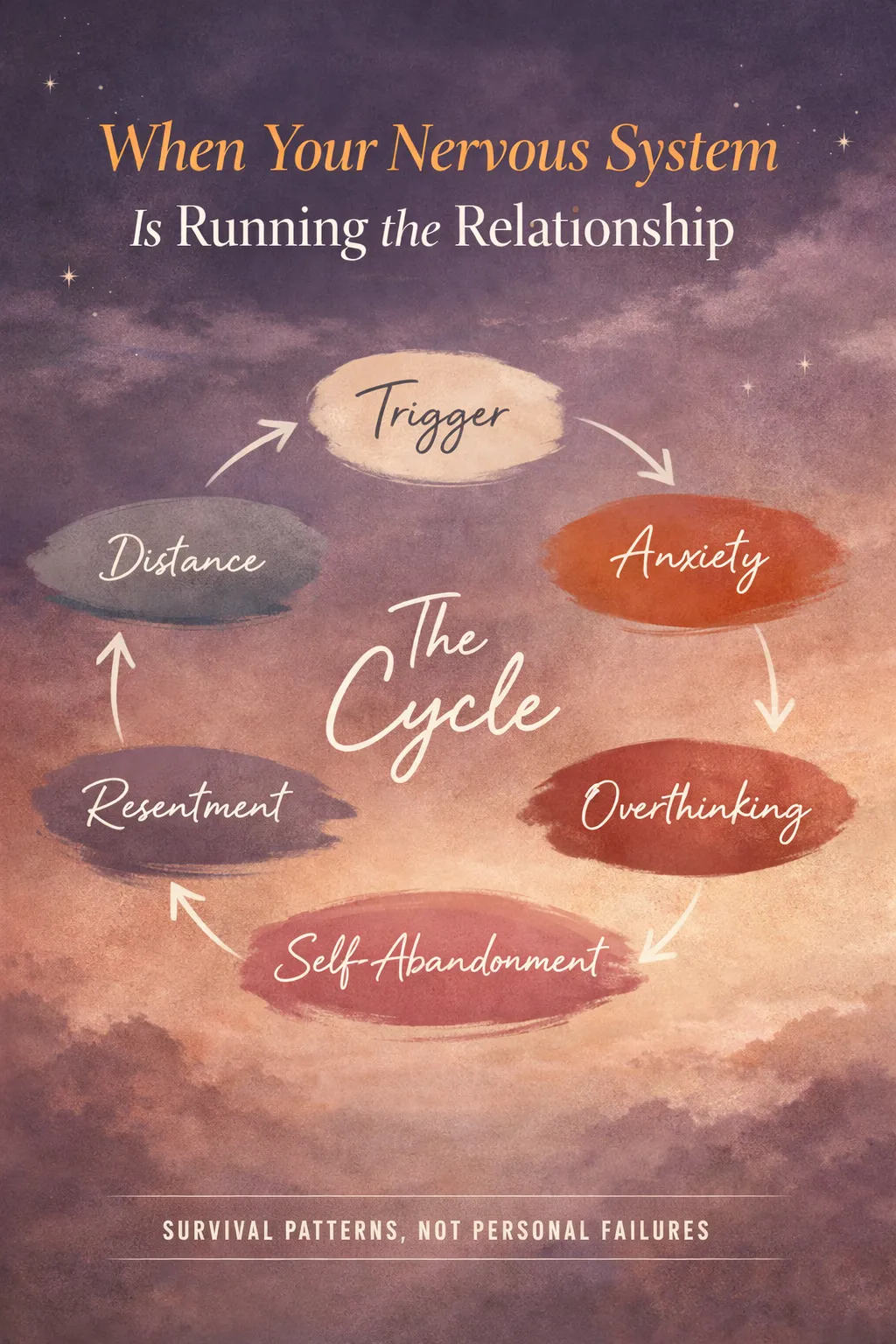
Trigger → Anxiety → Overthinking → Self-Abandonment → Resentment → More Distance → (and back to Trigger)
At first glance, it feels like the problem is the relationship, the other person, or the latest argument. But underneath, what’s really happening is a predictable survival cycle trying to keep you safe—just in ways that no longer work.
Let’s break it down.
1. The Trigger
A trigger is the moment something hits a sensitive spot.
It might be:
An unanswered text
A change in tone
Feeling ignored or excluded
A canceled plan
Emotional or physical distance
The trigger itself isn’t the real problem. It activates an older wound—fear of abandonment, not being chosen, not being enough, or being left alone with your feelings.
Your body registers this as danger, even if your rational mind knows it’s not an emergency.
2. Anxiety Takes Over
Once the trigger hits, your nervous system goes into alert mode.
You might notice:
Tightness in your chest or stomach
Restlessness or agitation
A sense of urgency or dread
Feeling emotionally unsafe
This isn’t weakness. It’s your body trying to protect you from getting hurt again.
The problem? An anxious nervous system doesn’t think clearly—it scans for threats.
3. Overthinking Tries to Regain Control
Anxiety pulls your mind into overdrive.
You might start:
Replaying conversations
Reading between the lines
Imagining worst-case scenarios
Trying to “figure it out” or get certainty
Overthinking feels productive, but it’s really an attempt to control uncertainty. Instead of calming you, it usually feeds the anxiety.
4. Self-Abandonment Enters the Chat
To make the anxiety stop—or to keep the connection—you may start leaving yourself.
This can look like:
Minimizing your own needs
Staying quiet to avoid conflict
Over-giving or over-explaining
Chasing reassurance
Ignoring your own boundaries
In other words, you trade self-respect for temporary relief.
It works for a moment. And then it costs you.
5. Resentment Builds Quietly
When you keep abandoning yourself, something inside you keeps score.
You might notice:
Irritability or emotional numbness
Feeling unappreciated or unseen
Pulling away or shutting down
A growing sense of “this isn’t fair”
Resentment isn’t the problem—it’s a signal. It’s what happens when your needs go unmet for too long.
6. More Distance… Which Creates the Next Trigger
Resentment and self-protection create distance—emotionally, sometimes physically.
That distance becomes the next trigger.
And the cycle starts again:
Trigger → Anxiety → Overthinking → Self-Abandonment → Resentment → Distance.
Round and round it goes.
Why This Loop Is So Hard to Break
Because this isn’t just a “mindset issue.” It’s a nervous system pattern.
Your body learned, at some point, that connection feels unsafe, unpredictable, or easy to lose. So it developed strategies:
Hyper-vigilance
Overthinking
People-pleasing
Self-silencing
Emotional withdrawal
These strategies once helped you survive.
They just don’t help you feel safe, secure, or close anymore.
The Real Exit: Self-Trust Instead of Self-Abandonment
Breaking this cycle doesn’t start with fixing the relationship.
It starts with:
Regulating your nervous system
Interrupting overthinking
Stopping the habit of leaving yourself
Learning to tolerate discomfort without betraying your needs
Choosing self-trust over survival strategies
When you stop self-abandoning, resentment has less reason to grow.
When your nervous system feels safer, anxiety has less control.
When you respond instead of react, the loop begins to loosen.
You’re Not Broken. You’re Patterned.
If you see yourself in this cycle, let me say this clearly:
You’re not broken. You’re patterned.
And patterns can be unlearned—with the right support, the right pace, and a lot of compassion for the parts of you that were just trying to stay safe.
The goal isn’t to become numb, detached, or “unbothered.”
The goal is to stay connected to yourself—even when things feel uncertain—so you don’t have to keep living in the same loop.