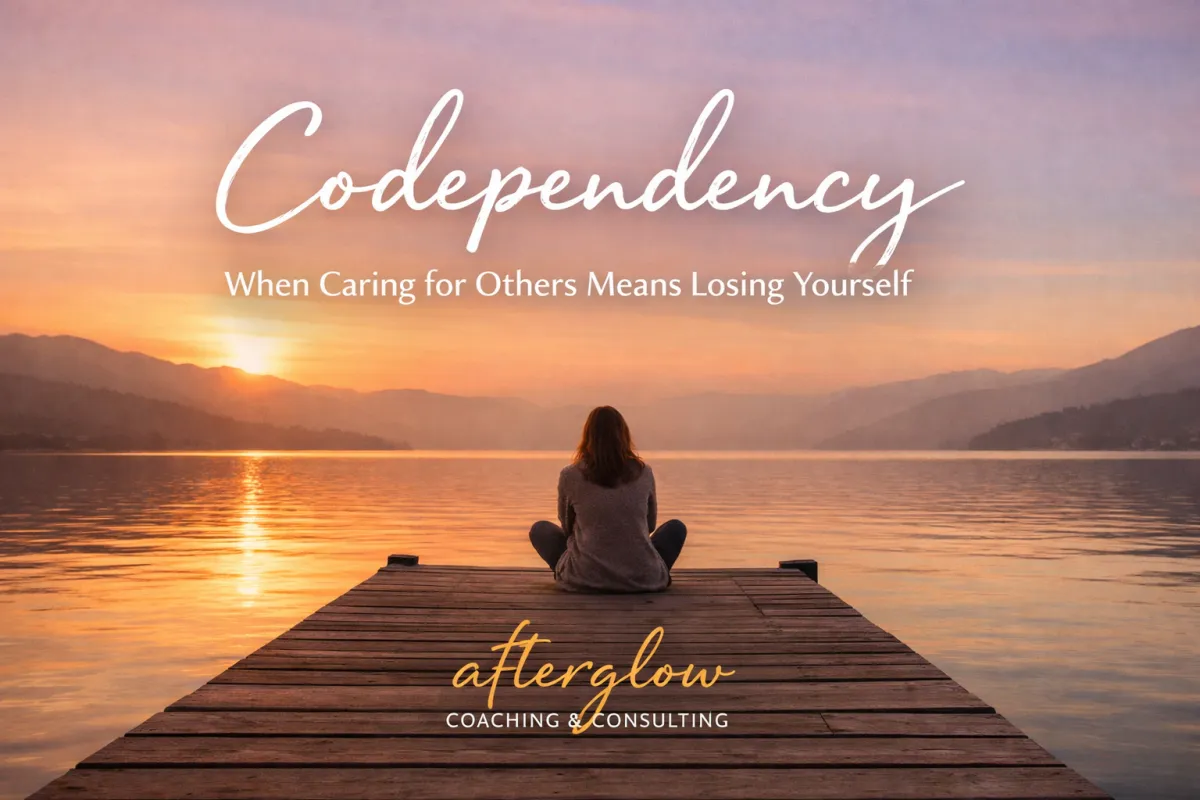
Codependency: When Caring for Others Means Losing Yourself
Codependency: When Caring for Others Means Losing Yourself
Many people hear the word codependency and immediately think it means loving someone too much.
But that’s not quite accurate.
Codependency isn’t about love.
It’s about losing yourself while trying to keep someone else okay.
At its core, codependency happens when another person’s emotions, approval, or stability begin to determine your own sense of safety and worth.
When they are happy, you feel relief.
When they are upset, distant, or disappointed, your nervous system goes into overdrive.
You may find yourself trying to fix, manage, explain, soothe, or anticipate their needs — often before they even express them.
Over time, your identity can slowly shift from being a person to being a caretaker of someone else’s emotional world.
And most people who struggle with codependency aren’t weak, needy, or overly sensitive.
In fact, they are often some of the most empathetic, self-aware, and deeply caring people you will meet.
The problem isn’t that they care.
The problem is that somewhere along the way, they learned that caring for others was the only way to feel safe or loved.
Where Codependency Often Begins
Codependency doesn’t usually start in adulthood.
It often begins much earlier.
Many people who struggle with codependent patterns grew up in environments where emotional safety was unpredictable.
Maybe love felt conditional.
Maybe someone in the household struggled with addiction, mental health challenges, or emotional volatility.
Maybe you learned that keeping the peace was more important than expressing your own needs.
In those environments, children learn powerful survival strategies.
They learn to read the room.
They learn to sense tension before anyone speaks.
They learn to regulate other people’s emotions in order to protect themselves from conflict, rejection, or instability.
What begins as a childhood survival skill can quietly become an adult relationship pattern.
Instead of asking:
What do I need?
The question becomes:
What does everyone else need from me right now?
Signs of Codependency
Codependency can show up in subtle ways that many people don’t immediately recognize.
Some common signs include:
• Feeling responsible for other people’s emotions
• Difficulty saying no without guilt
• Over-explaining yourself to avoid conflict
• Trying to fix problems that are not yours to solve
• Feeling anxious when someone is upset with you
• Prioritizing other people’s needs while ignoring your own
• Struggling to set or maintain healthy boundaries
• Feeling a strong need to be needed
Many people also experience something deeper beneath the surface: a fear of abandonment or rejection.
Because when your nervous system learned that love depends on caretaking, it can feel terrifying to stop.
Even when you’re exhausted.
Even when you’re overwhelmed.
Even when you know something isn’t healthy.
The Cost of Codependency
At first, codependency can look like kindness, generosity, or loyalty.
But over time, it often comes at a significant emotional cost.
You may feel drained, resentful, or unseen.
You might realize that you show up fully for others while your own needs remain unmet.
Sometimes relationships become imbalanced, where one person is constantly giving while the other is receiving.
Eventually many people reach a moment where they quietly ask themselves:
Why do I feel like I disappear in my relationships?
That question can be painful.
But it can also be the beginning of something incredibly important.
Healing Codependency: Returning to Yourself
Healing codependency is not about becoming cold, detached, or uncaring.
It’s about learning how to care for others without abandoning yourself.
That process often involves reconnecting with parts of yourself that were pushed aside for years.
It means learning to recognize your own emotions, needs, and boundaries.
It means allowing yourself to say no without believing you are selfish.
It means understanding that someone else’s feelings are not always your responsibility to manage.
And perhaps most importantly, it means beginning to trust that your worth is not dependent on how much you give to others.
You are allowed to exist as a full person — not just as someone who holds everything together.
The Afterglow Perspective
In trauma-informed coaching, we often look at codependency through the lens of the nervous system and attachment patterns.
Codependent behaviors are rarely a personality flaw.
They are often adaptive responses learned in environments where connection felt uncertain.
When people begin to understand their nervous system patterns, something powerful happens.
Instead of blaming themselves, they start developing awareness, compassion, and new tools for healthier relationships.
Healing becomes less about “fixing yourself” and more about relearning safety, boundaries, and self-trust.
And when that happens, relationships begin to change too.
Because the healthiest connections are not built on caretaking.
They are built on mutual respect, emotional responsibility, and authenticity.
You Can Love Without Losing Yourself
If you recognize yourself in these patterns, you are far from alone.
Many people spend years believing their role in relationships is to hold everything together.
But healing makes something else possible.
You can still be compassionate.
You can still care deeply.
You can still show up for the people you love.
But you can also remain connected to yourself while doing it.
And that is where real balance — and real freedom — begins.
About Afterglow Coaching & Consulting
At Afterglow Coaching & Consulting, we work with people navigating anxiety, attachment patterns, burnout, and relationship dynamics. Our trauma-informed coaching approach focuses on nervous system regulation, self-awareness, and rebuilding a strong sense of self.
If you are ready to explore healthier relationships — including the one you have with yourself — you don’t have to do that work alone.
Learn more at afterglowcoach.com